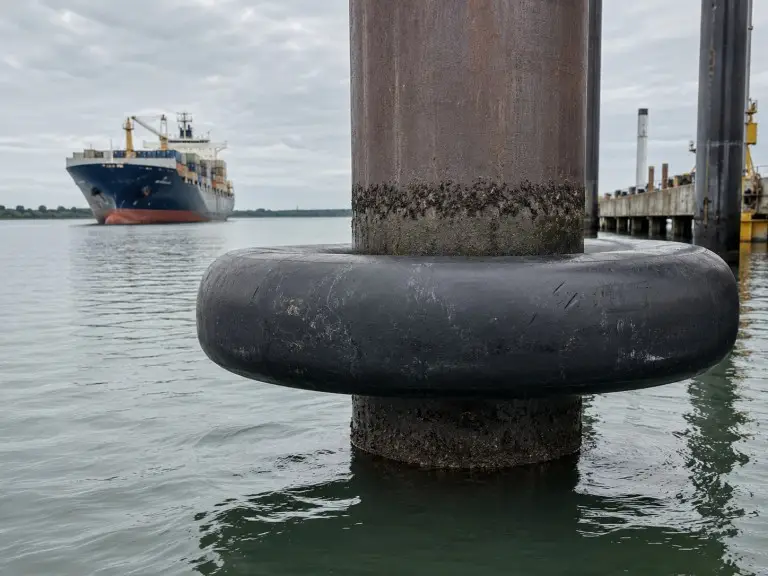
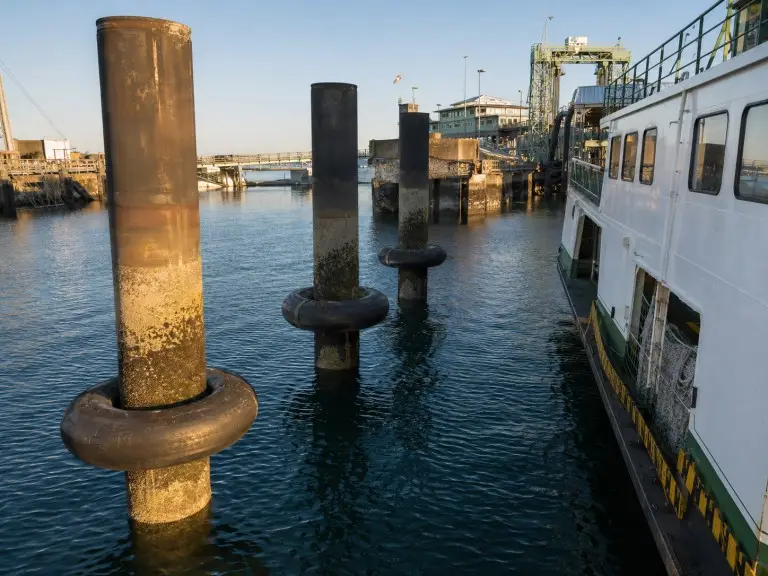
A donut fender is a ring-shaped foam fender that slides over a vertical monopile and floats with the tide. Fixed rubber fenders bolt to quay walls and stay in one spot. A donut fender rotates around the pile when a vessel pushes against it. This spreads berthing energy across a wider surface and lowers hull pressure at the contact point. Few other fender types can adjust to both tidal range and approach angle without manual repositioning.
Choosing the right donut fender depends on pile diameter, vessel size, tidal range, berthing energy, and the role of the monopile. This article focuses on how donut fender sizing logic differs from standard foam fender selection, which variables drive the decision, and which assumptions cause failures in the field. It does not cover installation procedures or maintenance schedules — those require separate project-level guidance.
How a Donut Fender Differs from a Standard Foam Fender
A donut fender uses the same core materials as a standard foam filled fender: closed-cell polyethylene foam, nylon-reinforced polyurethane skin, and internal steel structure. The key difference is inside the central bore. A galvanized steel sleeve lined with UHMW-PE bearing pads lets the fender slide up and down and rotate around a fixed pile.
This sleeve-and-pile interface creates constraints that chain-suspended foam fenders never face. The bore must leave enough clearance for the UHMW-PE liner, pile coating, installation tolerances, and years of marine growth. If the clearance is too tight, the fender jams at low tide. If it is too loose, the fender tilts under load and wears unevenly along the skin edges.
The liner allows rotation during vessel contact — but only when pile conditions cooperate. Marine organisms colonize the pile surface over time. Clearance that works at commissioning may not work three years later without pile maintenance.
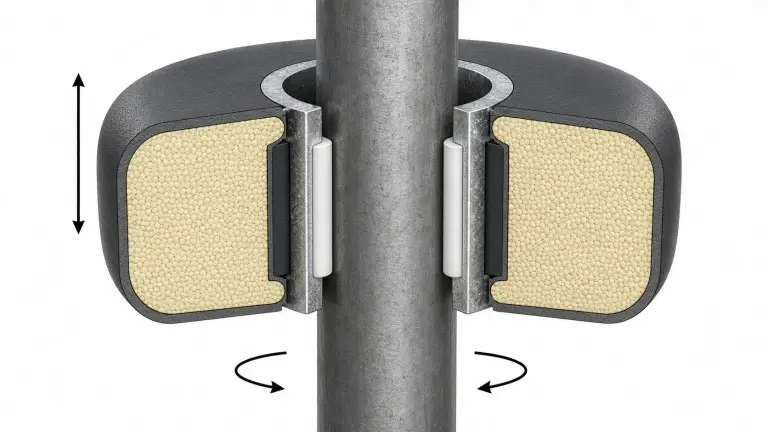
Foam density selection works differently too. In a chain-hung foam fender, the full foam cross-section absorbs energy uniformly. In a donut fender, the central bore reduces available foam volume, and oblique vessel contact shifts the compression zone toward the skin edge. A foam fender density grade that works in a suspended unit of the same outer diameter may underperform on a monopile. The effective compression area is smaller, and the load path is harder to predict.
| Factor | Standard Foam Fender | Donut Fender |
|---|---|---|
| Mounting | Chain or net suspended | Slides over fixed monopile |
| Movement | Floating / swinging | Vertical sliding + 360° rotation |
| Primary wear risk | Chain fatigue, skin abrasion | Bore clearance, liner wear, pile roughness |
| Design checks | Energy, reaction force | Energy, reaction force + pile clearance + tidal travel + pile load |
| Maintenance focus | Chain, net, skin | Liner, pile coating, marine growth |
Why Common Sizing Assumptions Lead to Field Failures
Many project teams pick a donut fender using energy ratings from a standard foam fender catalog. They skip the bore-to-pile clearance check and ignore tidal range. The result is a fender that binds on the pile at low water or stays tilted after a berthing event. We have seen this happen when bore clearance was too tight to handle two years of marine growth on the pile.
Static compression test data creates a related problem. Lab tests compress the fender with a flat panel. In the field, vessels hit the fender at an angle, creating combined axial and rotational loads. A fender rated for a given energy capacity in the lab may deliver higher hull pressure at an oblique contact angle. The compression patch shifts toward the skin edge instead of centering on the foam core. We recommend checking published performance data against the actual approach angle and hull shape at the berth.
Tidal range adds a third variable. In locations with more than 4 meters of tidal swing, the fender travels up and down the pile every day. Rough pile surfaces, corrosion, or exposed weld seams wear down the UHMW-PE liner faster. Over time, this friction can lock the fender in place. Pile surface condition should be checked before finalizing the fender specification. Standard foam fender selection never includes this step because suspended fenders do not touch the pile.
Where Donut Fenders Solve Problems That Other Fenders Cannot
Donut fenders do not replace all other fender types. They solve specific problems at monopile structures with tidal variation and multi-angle vessel contact.
- Breasting dolphins in tidal berths are the most common use case. The fender absorbs berthing energy while rising and falling with the tide. This removes the need for fixed fenders at multiple elevations. Ferry terminals, LNG jetties, and offshore supply bases rely on donut fenders at breasting dolphins because they handle vessels across the full tidal window.
- Turning dolphins and lead-in structures guide vessels during approach rather than absorbing full berthing loads. Rotation matters more than peak energy absorption in this role. The fender compresses and spins as the hull slides along it. We match fender height and foam density to expected sliding distance and contact duration, which differ from the instant impact loads used in breasting calculations.
- Bridge pier protection follows a different design logic. These fenders guard against accidental vessel strikes, not routine berthing. The design must account for maximum credible vessel impact, navigation risk, waterway conditions, and pier capacity. Standard berthing energy formulas do not apply. Local authority rules and navigation risk studies govern these projects.
Offshore wind monopiles and submarine jetties also use donut fenders. Each introduces its own variables — wave motion, subsea counterweights, or limited maintenance access — and requires a separate evaluation.
Sizing Variables and the Engineering Inputs That Drive Them
Donut fender sizing links five variables that cannot be set independently. The process should follow recognized guidance such as PIANC WG33 (updated by PIANC WG211) and BS 6349-4. These references cover berthing energy calculation, reaction force limits, hull pressure checks, and performance correction factors.
| Variable | Why It Matters | Required Input |
|---|---|---|
| Pile diameter | Sets bore size, liner clearance, rotation behavior | As-built outer diameter, coating thickness, marine growth allowance |
| Fender outer diameter | Controls energy absorption and hull-to-pile standoff | Target energy absorption, minimum standoff |
| Foam density | Balances energy absorption against hull pressure | Maximum allowable hull pressure for vessel type |
| Tidal range | Sets vertical travel distance and pile length need | LAT/HAT data, pile cap and mudline elevations |
| Berthing energy | Sets minimum fender performance | Displacement, velocity, angle, added mass, eccentricity, frequency, single or multi-fender contact |
The most overlooked input is pile diameter. Specifically, the gap between the design drawing and the as-built dimension. We check the actual pile diameter and surface condition before confirming bore size. Design drawings and installed piles often differ by 10–20 mm. That gap alone can decide whether the fender slides freely or jams.
Berthing energy calculation should cover vessel displacement, approach speed, berthing angle, added mass, eccentricity, navigation conditions, berthing frequency, and whether the vessel hits one fender or several. These inputs should follow PIANC WG211 or equivalent guidance before the team picks fender size and foam grade.
Optional accessories — mooring crowns, protective netting, non-marking skin, custom colors — change fender weight and buoyancy. We recalculate buoyancy after adding any accessory to confirm the fender holds its correct waterline position across the full tidal range.
Matching Donut Fender Specifications to Your Berthing Conditions
Donut fender selection comes down to aligning foam density, bore clearance, and outer diameter with the vessel profile and tidal conditions at your berth. No catalog selection replaces a project-level check against as-built site conditions.
In our experience building donut fenders for ferry terminals, offshore dolphins, and bridge protection projects, bore-to-pile clearance and foam density cause the most field problems — not the overall fender size. When operators assume wider clearance is always safer, the fender tilts under load and wears unevenly. When they pick the densest foam for maximum energy absorption without checking hull pressure, the vessel’s coating takes damage that costs more than the fender.
To get a specification matched to your project, prepare the pile diameter (as-built, not design), vessel particulars, tidal data, and berthing frequency. Contact our engineering team with these inputs. We will return a recommendation with performance curves for your operating conditions.
FAQ
A properly sized donut fender on a smooth, well-coated pile typically lasts 10 to 15 years. Heavy-use ferry berths, corroded piles, marine growth buildup, or repeated overloads shorten that number. Project the actual lifespan from your site’s duty cycle, not from catalog claims.
No. The closed-cell foam core does not absorb water. The fender stays afloat even with punctures or tears in the skin. Skin damage does speed up UV wear on the exposed foam, so schedule repairs once you spot it.
A donut fender has a foam core and slides over a fixed monopile. A Yokohama fender uses compressed air and hangs from chains. Donut fenders protect monopile structures across tidal ranges. Yokohama fenders handle ship-to-ship transfers and open-berth scenarios. The two fall on opposite ends of the pneumatic vs foam filled fender spectrum.
Start with the as-built pile diameter, vessel displacement and speed, berthing angle, tidal range, and pile structural capacity. We calculate berthing energy per PIANC guidelines, pick the right foam density, and verify the outer diameter gives enough standoff. Send these project inputs to our engineering team for a validated specification.